Sometime in the 1990s, TriMet staff came to a monthly board meeting of the Sellwood-Moreland Improvement League, the neighborhood association known as SMILE. They brought news of a planned light rail line through Inner Southeast Portland, with a station at the north end of Westmoreland. To justify the station, they asked that the blocks around it be rezoned for high-density residential. SMILE agreed and the city rezoned the land, according to a September 2025 editorial in The Bee, the neighborhood's newspaper.
The zoning stayed. The station never came. That decision from thirty years ago still shapes where Sellwood-Moreland's newest buildings go, and it changes how a buyer comparing this neighborhood with others should read its prices.
A station that stayed on paper
A funding vote for the line failed, the project went quiet for two decades, and when the Orange Line finally opened, the "Harold Street Station" was just an asterisk on the map. The paper reports that on the day the line opened, north Westmoreland lost three direct downtown buses, which took its bus service from five lines to two. The nearest MAX stops ended up at SE Holgate to the north and SE Bybee to the south, which The Bee calls the longest gap between stations on the Orange Line in Multnomah County.
SMILE, the Eastmoreland Neighborhood Association and the Reed Neighborhood Association have all asked on the record for the station to be added, along with a foot and bike bridge over McLoughlin and the rail yard at Reedway Street. The Bee wrote in 2025 that TriMet had been dismissive, but that it had once said a station might be considered if that bridge were built.
For a buyer, the bus schedule is the practical part. Line 70 runs along SE Milwaukie Avenue and 17th through Sellwood. On August 23, 2026, TriMet shortened it to run only between Milwaukie and Rose Quarter Transit Center. The weekday timetable that took effect November 15, 2026 shows buses about every 20 minutes for much of the day and about every 30 minutes in the evening. TriMet has said it will propose more cuts this fall for next year, so check the schedule against your own commute before you commit. SMILE's transportation committee noted in January 2026 that the only proposed change inside the neighborhood was Line 19 becoming Line 4.
Where 1,665 new units went
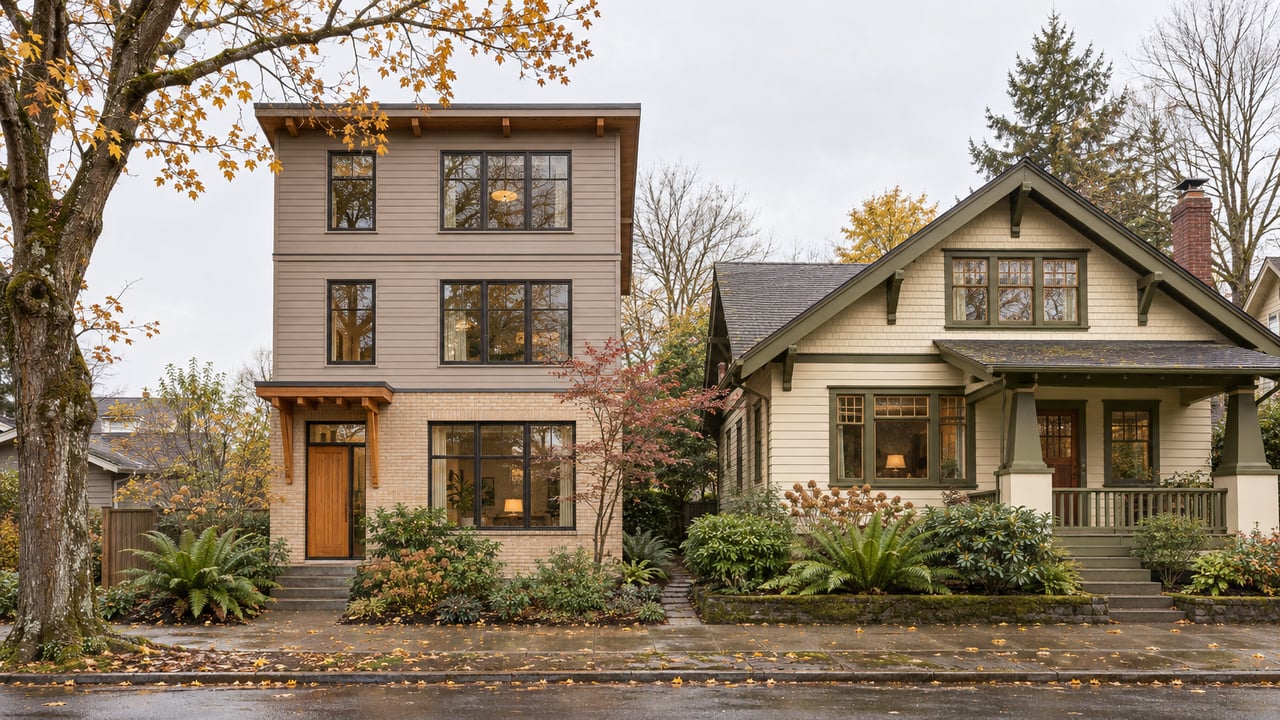
The density arrived without the station. At a SMILE meeting in September 2025, David Schoellhamer of the association's Land Use Committee said 1,665 units had been added to the neighborhood since 2015, a 38% population increase over that time, with 612 more apartment units in the pipeline. The Bee noted that this one neighborhood, out of Portland's 95, had built well ahead of most of the city.
The Bee wrote that the main concern among north Westmoreland residents was the large number of apartment buildings that have gone up there, especially north of Ellis Street.
The largest one planned so far sits on the edge of the Oaks Bottom bluff at 5515 SE Milwaukie Avenue, between Ellis and Insley. At a March 20, 2025 design advice hearing, the Portland Design Commission reviewed it as a seven-story, 243-unit building with parking on the ground floor, from GBD Architects. The Bee reported that commissioners did not like the two-block-long "wall" of the building, and SMILE asked that the design follow the Sellwood Moreland Main Street Design Guidelines. By September 2025 the developer was describing 240 units, possibly 238. SMILE's Land Use Committee recorded in November 2025 that the design and River Review approvals had not been appealed.
The next possible sites line the same commercial spines. SMILE's February 2026 Land Use Committee minutes list the US Bank property at 7000 SE Milwaukie, possibly mixed use with underground parking, and the LDS church at 7880 SE Milwaukie as places that may be redeveloped, though nothing was happening yet. The minutes also mention the north end of the Master Mechanics building at 8018 and 8036 SE 17th, which had been partly torn down, and the food cart lot at SE Spokane and 17th, which the committee described as having "much potential." The same minutes say The Morgan apartments at 1650 SE Tacoma finally had a business on the ground floor after the space sat empty for years.
Every one of those addresses is on Milwaukie Avenue, 17th or Tacoma.
What the 2025 sales say about the houses
If 1,665 new units had been competing with houses for the same buyers, you would expect Sellwood-Moreland's premium to shrink. It hasn't. Portland Monthly's neighborhood table, built from 2025 RMLS data and published April 13, 2026, shows a 2025 median sale price of $660,000 for Sellwood-Moreland, an average of $677,699, and 183 homes sold. Citywide, the 2025 median was $515,000, which puts the neighborhood about 28% above Portland as a whole.
The premium per square foot is smaller. Sellwood-Moreland sales averaged $346 a square foot in 2025, against $309 citywide, so about 12% more. Homes here sold at an average of 1,960 square feet, a bit larger than the city's 1,884. Part of the gap in median price comes from what sells here, and part from where it is.
The premium is also not widening. The neighborhood's median rose 2% from 2024 to 2025 and 16% from 2020 to 2025. Over the same windows, Portland's median rose 3% and 22%. Homes here averaged 46 days on market in 2025, against 52 citywide. Sellwood-Moreland is still a step up from the city, and it hasn't pulled further ahead over the past five years. A decade of new units has neither erased the gap nor widened it.
The mix of sales points the same way. Condos made up 21% of Sellwood-Moreland's 2025 sales, compared with 19% citywide and 7% in neighboring Woodstock, where the 2025 median was $560,725. The average home sold here in 2025 was built in 1959, against 1962 citywide, so buyers here are mostly buying older homes even with condos in the mix.
For a more recent read of the wider market, look to RMLS's October 2026 report, the broad Southeast Portland area had a median sale price of $507,500 for the month, an average of $563,100, and 39 days of total market time. That area covers much more than Sellwood-Moreland and doesn't split detached homes from condos, so treat it as the direction of the wider market rather than a price for these blocks.
Reading the neighborhood block by block
For a buyer weighing Sellwood-Moreland against Eastmoreland, Woodstock or Richmond, the 2025 figures say the neighborhood holds its value well compared with the city. The building record says change here comes in a pattern you can predict.
A house on a side street well away from Milwaukie Avenue and 17th sits away from every site on SMILE's list. A house near the north end of Milwaukie Avenue, close to Ellis, Insley and Harold, is next to the corridor where the 1990s zoning is still producing buildings, and where the transit those buildings were zoned for hasn't come. A home within a block or two of 7000 or 7880 SE Milwaukie, or the 17th Avenue lots near Spokane, faces sites SMILE has flagged as possible future redevelopment. Change on those sites could mean a new neighbor building, ground-floor shops, or both.
None of that makes one block better than another. It decides what you are buying into. For a buyer who wants to be close to Line 70, the corridors are where the bus runs. For a buyer who wants an older detached house with nothing likely to change next door for years, the map of SMILE's watch list is a good place to start.
The neighborhood's civic life runs through the same few places. Our October look at how Sellwood's small fall events fund next summer's concerts covers The Shack and the Sellwood Park calendar, and the Sellwood neighborhood page has the broader picture.
A few questions buyers ask
Where does the Sellwood Bluff building on Milwaukie Avenue stand? SMILE's Land Use Committee recorded in November 2025 that its design and River Review approvals had not been appealed. Before you buy nearby, walk the site and look up its current permit status.
Will a Harold Street MAX station change north Westmoreland values? The Bee's September 2025 editorial describes the station as a long-running neighborhood request that TriMet had been dismissive of. Price a home on the transit it has today.
Are Sellwood-Moreland prices still rising? In 2025 the neighborhood's median rose 2%, slightly behind Portland's 3%, and it stayed well above the citywide median.
If you're deciding between a house on a quiet Sellwood side street and a condo closer to Milwaukie Avenue, or trying to tell which blocks sit near SMILE's redevelopment list, Daniel Treacy can walk those streets with you and go through recent sales block by block. Let's Connect.