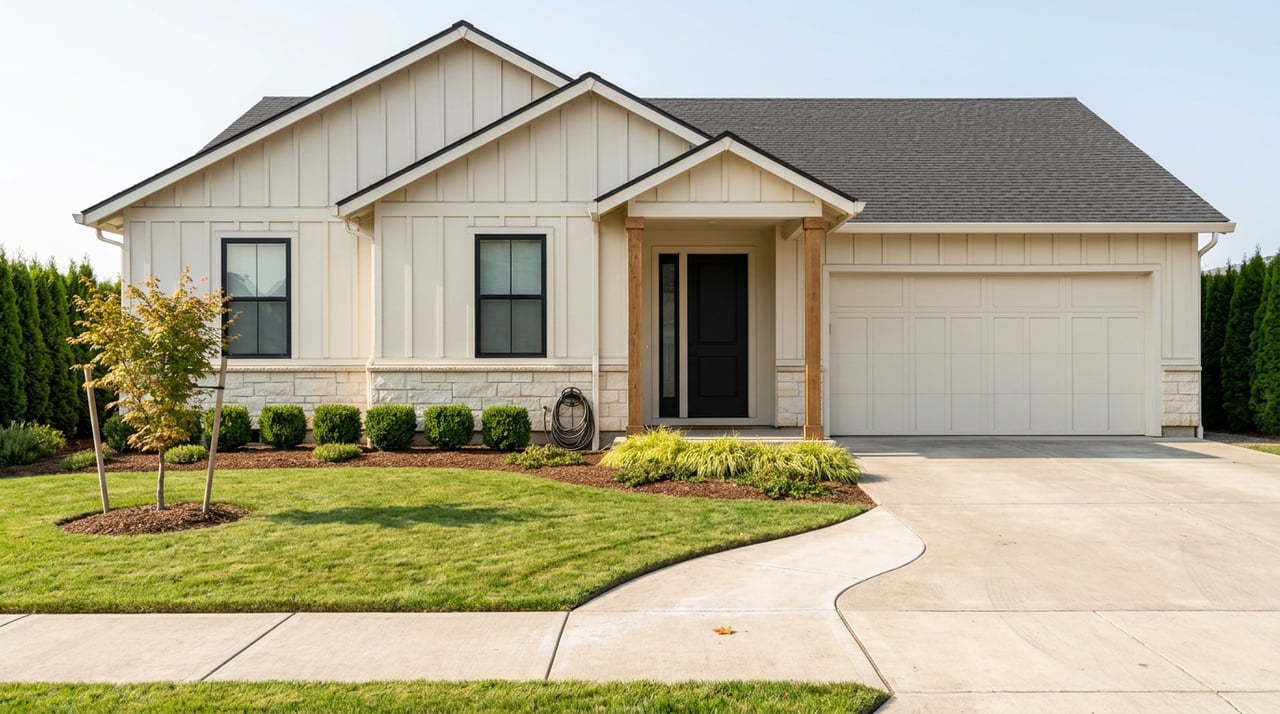
Ridgefield's median home price is climbing. So is the average number of days a new home sits before it sells. Normally those two lines move in opposite directions. Right now in Ridgefield, they're both going up at the same time, and new-construction incentives are one factor to consider alongside the market figures.
Two numbers that shouldn't sit side by side
Over the three months ending May 2026, Ridgefield's median sale price ran about $650,000, up 7.4% from the same period a year earlier. That's a healthy number, the kind that shows up in a headline and suggests a market with momentum.
Here's the part that doesn't fit the story. Homes in Ridgefield's new-construction segment were sitting on the market an average of 54 days and drawing roughly one offer apiece as of mid-June 2026, out of about 100 active new-build listings with a median list price near $703,000. A market where prices are climbing 7.4% a year should not also be a market where the typical new listing gets a single offer and takes nearly two months to find a buyer. Rising prices and slowing pace usually don't travel together. In Ridgefield right now, they are.
Whose "average" are we even using
Zillow's citywide index put Ridgefield's average home value at $678,842 as of May 2026, up half a percent from a year earlier. That's about as unremarkable as a housing number gets, the kind of flat, steady line that suggests nothing unusual is happening in either direction.
But an average across an entire city blends new construction, forty-year-old ranch homes, half-acre view lots, and townhome-style product into a single number that doesn't describe any specific transaction you're actually comparing. It also can't show whether a buyer received a builder-paid interest-rate incentive, which may affect the effective cost without appearing in the headline sale price. If you're deciding between a resale listing and a new-build community two streets over, the citywide average tells you almost nothing about what either one will actually cost you at closing.
How builder incentives affect the price comparison
New-construction prices and financing incentives are useful to consider together. The listed price alone does not show the buyer's full financing or closing-cost terms.
Builders active across Ridgefield's newer communities offer financing incentives that buyers can compare with listed prices. A few examples:
- Pulte's Meadowview community has leaned on quick-move-in inventory, where the home is already built or nearly finished and builders have more room to negotiate on financing, closing costs, or minor upgrades because the base price is largely locked in.
- David Weekley Homes' Greely Farms, near the Ridgefield National Wildlife Refuge, pairs its homes with an industry-standard new-home warranty and has run limited-time financing incentives on top of that coverage.
- Toll Brothers at Quail Ridge, a gated community with homes ranging from roughly 2,790 to 3,618 square feet, gives buyers a Design Studio to customize finishes, which shifts the value conversation from price to personalization.
- Holt Homes' Ramble Creek and Generation Homes Northwest's Paradise community have both listed homes with pricing explicitly tied to builder incentive programs and in-house lender credits, so buyers can compare the listed prices with the incentives offered.
Here's the mechanism in plain terms: a builder can hold a $703,000 list price steady while covering a meaningful share of the buyer's interest rate through a temporary rate buydown, or offering a closing cost credit worth thousands of dollars. The list price stays unchanged. The buyer's monthly payment or closing costs can differ from what that price would suggest on its own.
A rising median price alongside financing incentives does not necessarily mean buyers are paying more for the same house.
How incentives affect resale comparisons
For buyers comparing an existing home with a new community, financing incentives can affect the monthly-payment comparison. A resale seller can offer a fair price, a clean inspection history, and a flexible closing date. When a buyer is cross-shopping a resale listing against a new community offering a lower effective monthly payment, the financing terms matter alongside the price.
The new-construction figures show longer days on market and fewer offers per listing, even as the reported median keeps climbing. New construction and resale homes are different segments, and the citywide numbers combine both.
If you're preparing to sell an existing home in Ridgefield, this is the single most useful thing to understand before you set a list price. A free home valuation that accounts for what's actually competing against your listing right now, not just what sold six months ago, matters more here than in a market where new construction isn't a factor.
The corridor behind the building boom
None of this incentive activity is random. Ridgefield keeps adding new communities because the city keeps adding capacity to support them. Road projects including the Pioneer Street widening and a new roundabout at Discovery Drive are aimed at easing the trip to I-5 and supporting growth along the Ridgefield Junction corridor, the stretch of the city where much of this new construction is concentrated. You can track active development activity directly through the City of Ridgefield's development map, which is updated regularly by the Community Development Department and gives a more current picture than any single builder's marketing page.
That infrastructure investment is part of why builders keep committing to new phases here rather than pulling back. It also means the incentive dynamic described above isn't a short-term blip tied to one slow season. As long as multiple builders are delivering product into the same corridor at the same time, financing incentives are likely to remain the primary lever, not price reductions.
What this actually means if you're comparing new construction to resale
If you're the kind of buyer weighing a quick-move-in home against an existing resale listing, the list price comparison you're probably running in your head is the wrong one. A few things worth doing instead:
- Ask every builder for their current incentive package in writing. Offers change by community and by month, and a verbal mention of "ask about financing" is not the same as a documented credit you can hold them to.
- Separate quick-move-in inventory from build-to-order. On a home that's already framed or finished, a builder has more flexibility on incentives because the base price is close to fixed. On a build-to-order lot, the value usually shows up in customization, not price movement, so don't expect the same kind of financing credit.
- If you're comparing a resale home to new construction, calculate the effective monthly cost of each, incentive included, rather than comparing sticker prices. Picture a resale home listed several thousand dollars below a comparable new build. If the new build carries a meaningful rate buydown, it can still work out cheaper per month than the resale option despite the higher sticker price.
- If you're relocating into Ridgefield from Portland or Vancouver and trying to sort all of this out alongside a cross-state move, it helps to separate the financing question from the neighborhood question entirely. Our guide to moving from Portland or Vancouver into Ridgefield covers the logistics side if that's the piece you're still working through.
A couple of questions worth asking directly
Does this incentive pattern apply to every new community in Ridgefield, or just a few? It varies. Larger production builders with in-house lending arms, the kind active at communities like Meadowview, Ridgefield Heights, and Sanderling Park, tend to lean on financing incentives more heavily than smaller custom builders working one lot at a time. Always ask what's currently on the table for the specific community and phase you're looking at, since offers shift monthly.
If new-construction financing incentives are doing some of the work behind rising median prices, does that mean resale homes are actually a better value right now? Not automatically. It depends on the specific comparison. A resale home with a lower price and no incentive attached can still be the better deal once you weigh in the cost of a newer roof, updated systems, and a warranty period you won't get on an existing home. The point isn't that one option beats the other. It's that comparing list prices alone, without accounting for what's baked into each one, will lead you to the wrong conclusion either way.
Ridgefield's market isn't contradictory once you look past the headline number. New construction and resale are different segments, and financing incentives can affect how buyers compare them. Knowing which one you're actually shopping in is the difference between a comparison that holds up and one that doesn't.
If you're trying to figure out where your specific situation, buying, selling, or both, actually lands in this, Daniel Treacy can walk through the real numbers behind whatever listing or community you're weighing. Let's Connect.